
Do Everyday Movements Cause You Pain?
Use the simple tests in the following blog to assess your normal everyday movements to gauge the health of your joints
Rachael Storr-Meddings
10/18/20254 min read
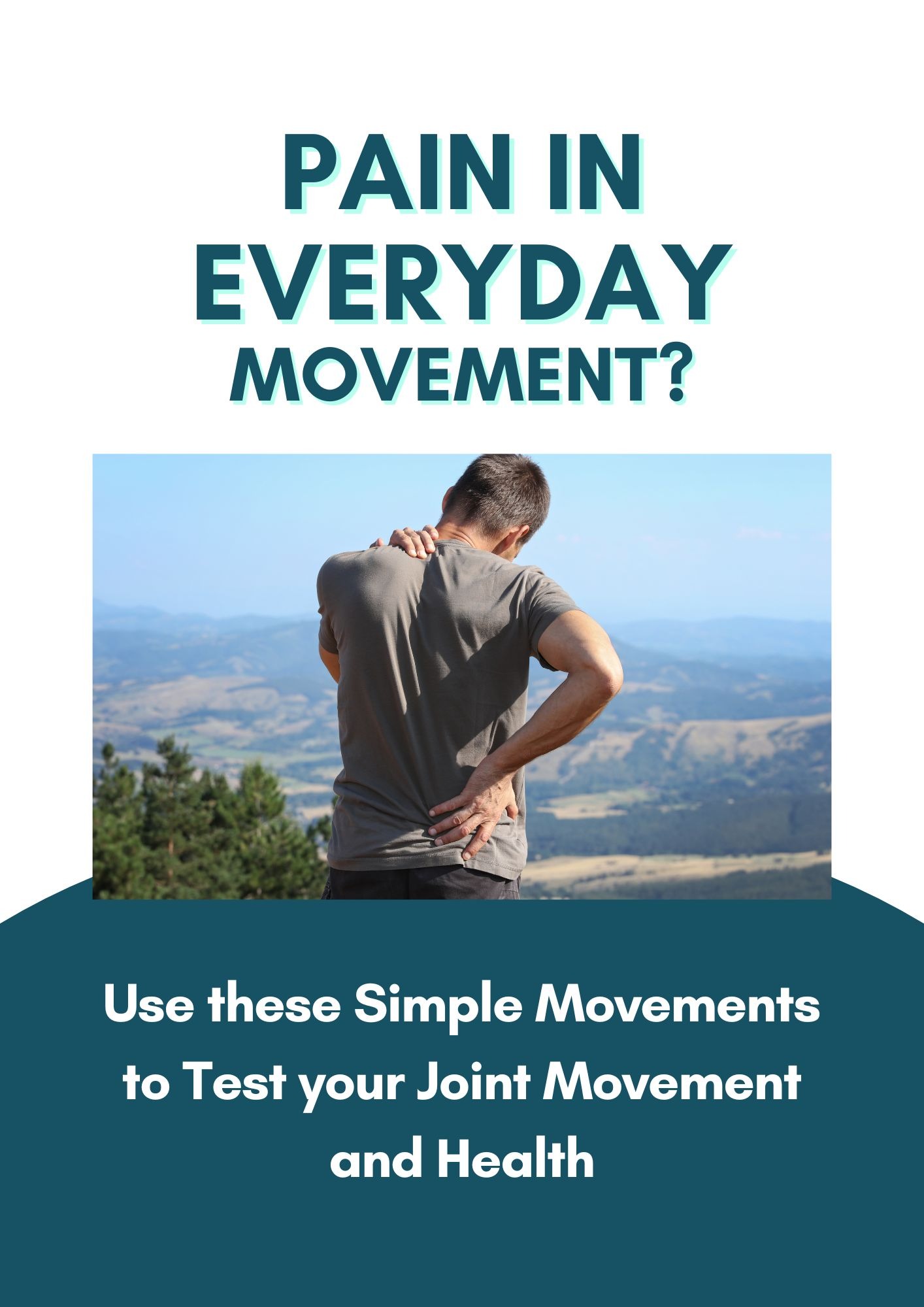
💥 Are These Everyday Movements Causing You Pain?
Ever noticed a twinge when bending to a low cupboard?
A sharp jab in your knee walking up stairs?
Or that reaching overhead is starting to feel… not so smooth?
These everyday movements — ones we should be able to do pain-free — often become harder or uncomfortable over time. And while it’s tempting to “just avoid” them, that can lead to bigger issues down the line.
So, how do you know if your body is moving well — or whether it’s time to get some help? Try these simple home tests to check in with your joint and movement health 👇
---
🏋️♂️ 1. The Squat Test
Why it matters: Squatting is essential for day-to-day tasks like using the loo, reaching low shelves, gardening, and even playing with kids.
Try this:
Stand with your feet shoulder-width apart and slowly squat down as if to sit in a chair.
* Can you get low without your heels lifting or your knees collapsing in?
* Do your hips, knees, or ankles complain?
* Is one side stiffer or more painful than the other?
*Is your weight centred? (use a mirror to see this if possible)
> ✅ Research has shown that squat depth and quality are closely linked to lower limb strength, ankle mobility, and long-term knee health (Macrum et al., 2012; Escamilla et al., 2001).
> Dysfunction here may contribute to knee osteoarthritis risk over time if unaddressed.
---
🧗♀️ 2. The Step-Up Test
Why it matters: Stairs are unavoidable (especially in Newquay!). Struggling with them often means you're compensating — usually with the back or opposite leg.
Try this:
Find a step and step up with one foot, then bring the other up to meet it.
* Can you do this without pain in the knee or hip?
* Does one leg feel weaker, less stable, or more wobbly?
* Can you step off forwards or backwards? (make sure you're using a hand support if you feel unsteady)
> ✅ Step-ups require adequate quadriceps strength, hip stability, and joint coordination — all of which tend to decline with age or after injury (Petterson et al., 2009).
> Pain here could indicate early movement dysfunction, especially post-surgery or injury.
---
🙆♀️ 3. Overhead Reach Test
Why it matters: Reaching into cupboards, putting on a shirt, or hanging washing, replacing the duvet cover all require good shoulder mobility and control.
Try this:
Lift both arms straight up beside your ears.
* Can you do it without arching your back or shrugging your shoulders?
* Any pain, stiffness, or catching?
> ✅ Studies on shoulder mobility (Ludewig & Cook, 2000) show that altered mechanics and muscle imbalances — especially involving the rotator cuff and scapula — are strongly associated with shoulder impingement and pain during overhead tasks.
---
📦 4. Bend and Lift Test
Why it matters: Lifting shopping, laundry baskets, or even pets requires coordination between your hips, back, and core.
Try this:
With feet hip-width apart, bend forward to pick something off the floor with soft knees.
* Do you feel tension in your lower back or hamstrings?
* Do you round your spine or avoid using your hips?
> ✅ Limited hip mobility and poor lifting strategies are associated with increased spinal load and back pain risk (Van Dieën et al., 1999; McGill, 2007).
> This is especially relevant in people with a history of back discomfort or sedentary habits.
---
⚠️ What Happens If You Avoid These Movements?
Avoiding painful or difficult movements doesn’t solve the problem — it shifts it elsewhere. Over time, this leads to:
* Muscle weakness and joint stiffness (often accelerating joint degeneration)
* Compensations (e.g., overloading other joints or the spine)
* Loss of movement confidence
And eventually… *more pain and injury risk*
> 🧠 A 2021 review in the Journal of Physiotherapy emphasised that early intervention and graded movement exposure improve function and prevent chronicity in musculoskeletal pain.
---
✅ What To Do Next
If any of those tests were difficult, painful, or just didn’t feel quite right — it’s a sign your body needs a little attention.
Newquay Injury Hub specialises in helping people move better, live pain-free, and build strength for the long term. Whether it's knees, hips, back or shoulders — everything is tailored to work with your goals, not just your symptoms.
📍 Book an assessment today and take the first step toward better movement and joint longevity.
Because life’s better when movement isn’t something you avoid.
---
References
Escamilla, R.F., Fleisig, G.S., Zheng, N., Lander, J.E., Barrentine, S.W., Andrews, J.R. and Moorman, C.T., 2001. Biomechanics of the squat. Medicine & Science in Sports & Exercise, 33(3), pp.376–391.
Macrum, E., Bolgla, L.A., Uhl, T.L., Grenier, S.G. and Reiman, M.P., 2012. Hip strength and hip and knee kinematics during stair descent in females with and without patellofemoral pain syndrome. Journal of Orthopaedic & Sports Physical Therapy, 42(8), pp.697–704.
Ludewig, P.M. and Cook, T.M., 2000. Alterations in shoulder kinematics and associated muscle activity in people with shoulder impingement. Physical Therapy, 80(3), pp.276–291.
Van Dieën, J.H., Cholewicki, J. and Radebold, A., 1999. Trunk muscle recruitment patterns in patients with low-back pain enhance spinal stability. Clinical Biomechanics, 14(10), pp.667–676.
McGill, S.M., 2007. Low Back Disorders: Evidence-Based Prevention and Rehabilitation. 2nd ed. Champaign, IL: Human Kinetics.
Petterson, S.C., Barrance, P.J., Buchanan, T.S., Snyder-Mackler, L., 2009. Quadriceps strength predicts functional performance after ACL reconstruction. Journal of Orthopaedic & Sports Physical Therapy, 39(6), pp. 403–409.
Journal of Physiotherapy, 2021. Interventions for musculoskeletal pain: early treatment benefits. Journal of Physiotherapy, 67(4), pp.219–228.
Assessment • Treatment • Rehabilitation • Movement Confidence
diagnosis, treatment, rehabilitation, movement, aches, pains, athletic performance
Newquay Injury Hub
© 2024. All rights reserved.
Do you have a question before booking?